
The Odyssey
The Redemption

I watched Christopher Nolan’s Odyssey in Tamil. That is what a south Indian town offers. I did not know it was dubbed into Tamil till I reached the theatre. I have transcreated English TV shows for a Tamil audience. The cardinal sin is literal translation — I believed so. But that sin turned out to be the honest expression. Provided you can forgive literal translations of phrases like “leave us alone,” the dubbed version gets you close to the English, not all the way. As ironic as the controversies — race swapping in the casting, damaging the true spirit of the epic, Nolan captured by politics.
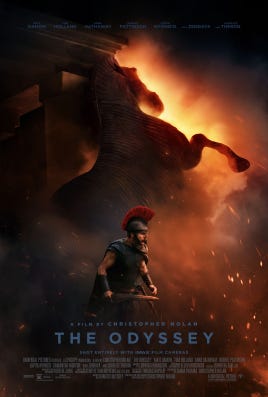
I stand outside the cultural premise. I have nothing to feel personal about the culture the movie portrays. But what I felt is still important to say. The race swap was irrelevant to what the movie is about. I recall a controversy in Tamil space.
More than a decade back, there was a motorbike advertisement depicting a Tamil Brahmin as a representation of “south India.” There were demonstrations against the ad. The company withdrew it, I remember. The ad was not a conspiracy. It was a mere Bollywood stereotype. The exaggerated accent, the vegetarianism, vibhuti — the holy ash — and a tuft typical to Brahmins. This is how Bollywood represents “Tamil” culture and “Madras.”
I understand this template mechanism intimately through my work in production music. “Indian music” for the American market is not authentically Indian. It should evoke Indianness in a familiar way. Sitar drones, tabla loops, pentatonic melodies. Whether they resemble actual Indian musical traditions is not the question. Templates flatten reality to make it consumable across cultures. I am not saying Hollywood does not understand Indian music. I am saying templates are how things travel.
A template turned out to be offensive in the bike advertisement. Not everyone cared, but a progressive segment did. The misappropriation was real — Brahmin identity does not represent the majority population. But it works for ads in north India. There is no easy way to portray the distinction between a non-Brahmin north Indian and a non-Brahmin south Indian. The misappropriation was convenient. Like Indian music for Hollywood.
There are around 300 Ramayanas. The Thai Ramakien, the Javanese Ramayana — these are cultural assimilation that took centuries. In Tamil Nadu, there are portrayals of Ravana as a Brahmin, as a non-Brahmin, as an asura, as a great scholar-king. The Jain Ramayana sees Ravana as demi-divine with powers. Rama, as a proper Jain, refuses to kill — so his brother Lakshmana has to. People rewrite stories, reframe narratives, shift blame between characters, redeem the condemned.
Tamil theatre icon R.S. Manohar’s biggest hit was a Ramayana. Ilankeswaran (Lord of Lanka), premiered in 1957, written by Thuraiyur K. Murthy. This version portrays Ravana as the father of Sita. There were controversies in Madras, but the play was a hit in Sri Lanka, staged continuously for more than two months. Sri Lankans loved a version that portrayed their king as noble. It became Manohar’s masterpiece, staged nearly 2,000 times. The story wanted to redeem Ravana. To give him dignity.
But Ravana was not the only one redeemed. Stesichorus wrote a poem that insulted Helen. He lost his eyes for the insult.
Then he rewrote:
"This tale is not true:
You did not go on the well-benched ships,
And you never reached the towers of Troy."
Stesichorus redeemed Helen. Redeemed himself. Redeemed his eyes.
In the play of Euripides, Helen has spent the entire war in Egypt, grieving, loyal to Menelaus, while a phantom caused the bloodshed.
People write, rewrite, adapt, arrange, interpret epics. Sometimes with political confidence. Sometimes with artistic conviction.
Ultimately, I cannot determine which side of the Odyssey controversy is performing and which is genuine. Is Nolan engaging in cultural activism, or are his critics genuinely protecting something sacred? The critics rarely frame it as hurt sentiment, yet that is precisely what underlies every objection. I cannot adjudicate — not because I stand outside the culture, but because performance is everywhere. Activism is performed all the time. Hurt sentiment is claimed all the time.
But I can be certain of one thing. Nolan’s is conviction. His film is not about the redemption of a character. It is about what redemption itself is.