

Socrates and the Death of Memory
The technology that let humans stop roaming was the sentence that stayed still.

Everything we know about Socrates comes from a man who betrayed him.
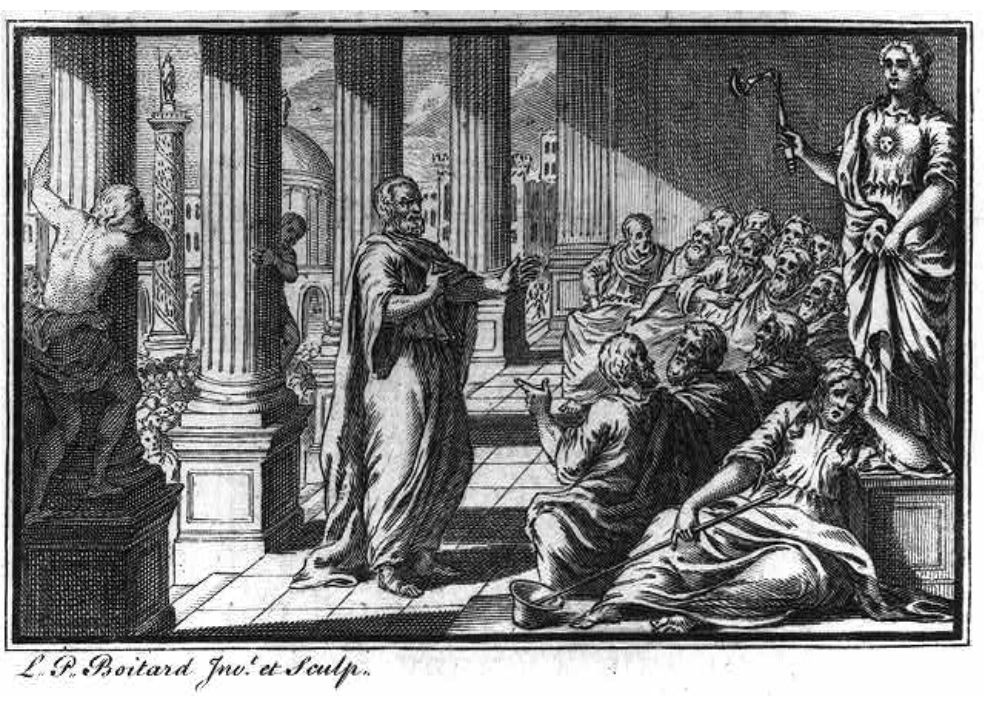
Not in the way Judas betrayed Jesus, or in the way Athens betrayed Socrates with hemlock. Plato’s betrayal was quieter, more loving, and more total. Socrates spent his entire life in dialogues. The unrehearsed, unscripted, uncomfortable back-and-forth of live dialogue. He never wrote. The man who defined the Western philosophy never wrote a single book. He believed that writing killed what it preserved.
Socrates thought writing would kill memory and the human roaming. He believed if something is in the book, it is not inside the reader. I understand he was worried about the disappearance of authentic knowledge of oneself.
His pupil Plato understood it, agreed with it. Allegedly in his Seventh Letter, he confessed— his important philosophical insights were never committed to text. They could only be sparked by living speech. He believed the pages could not hold the weight of deepest things. Maybe he was referring to the art of reading between the lines.
And then he spent the rest of his life writing.
Plato wrote down Socrates’ arguments against writing. He wrote down the dialogues that were not supposed to be the freeze corpus on a page. He made the corpus available to everyone, without its soul.
Plato was not a hypocrite. He made a compromise; it must had been a grief. He watched his teacher die: executed by the city Socrates had spent his life trying to wake up. Plato had to face the choice. Letting the method die with Socrates? or preserving it in the only medium that could carry it across centuries? He chose preservation. He chose writing.
He wrote dialogues. Staged encounters between characters who disagree, get confused, change their minds, reach no conclusion. To give the reader an experience. Not an answer.
It was a beautiful compromise and still a defeat. Because you are reading those dialogues right now, in silence, alone; Socrates or someone else is not there to ask you what you think you understood. There is no one on the other side except a page that doesn’t talk. Now, should we ask ourselves if we split ourselves and play the role of two counterparts while reading?
So, what was Socrates defending?
Memory could be the easy answer. In the Phaedrus, Socrates tells the story of the Egyptian god Theuth presenting writing to King Thamus. Theuth is proud that the invention will improve memory and make people wiser. Thamus refuses the gift. Writing won’t strengthen memory, he says. It will destroy it. People will rely on marks on a surface instead of cultivating understanding. They will mistake access to information for the possessing the knowledge.
Socrates endorsed the king. But it was not memory Socrates was concerned about. It was something a prerequisite to memory.
Before writing, knowledge required roaming. A duration where you sit with the question, situation unresolved, things without scaffolding, till something emerges organically. What emerges is yours and authentic. But writing gives you something without labor required. No roaming, no effort. Socrates was not concerned about the answer but about the process of inquiry.
His method had a specific destination, which was not an answer. It was aporia — the puzzle. You came in confident. You left confused. Your framework had been dismantled; you are proved that you are not the complete. A space is created between where you stand and what the truth is.
But this space required time. You had to sit in the not-knowing. You had to endure the discomfort of having your assumptions pulled apart without being given something tidy to replace them. The process took as long as it took, and it could not be shortened, because the shortening was the thing that killed it.
Writing offered exactly that shortening. You could read someone else’s conclusion and adopt it without ever having been broken open by the questioning that produced it. You could get the destination without the journey. The answer without the aporia.
And Socrates understood more clearly than anyone around him; that the journey was the knowledge. The aporia was not a delay on the way to understanding. It was the only way of understanding the truth.
Socrates was not the only one who saw this.
Half a world away, roughly a generation before Socrates was born, Gautama Buddha was doing the same thing. Buddha was roaming, questioning, refusing to write. He walked across northern India for forty-five years after his awakening, he adapted every teaching to the person in front of him. Gave two different questions in disguise of answer to two persons asking the same question. He gave answers completely differently to a brahmin, a farmer, a grieving mother. He called this upaya, skillful means. The truth was not a fixed thing to be delivered. It was something that could only be sparked in the encounter between this teacher and this student, right now.
And the Buddha had his own version of aporia. When asked the great metaphysical questions — is the world eternal? Is there life after death? He refused to answer any of these. Maybe he believed a fixed answer would have killed the inquiry — human roaming.
Twelve centuries later, Adi Shankara walked across India, roamed, like Socrates, like the Buddha, challenging the leading thinkers of every philosophical school he met. His debate with Mandana Mishra lasted weeks. The judge was Mishra’s own wife, Ubhaya Bharati. She measured the debaters not only by logic but by the wilting of their garlands. Truth was not just what you say. It was what you became while saying it.
A written text reveals nothing about what the writing did to its author. You can read a flawless argument written by someone who was falling apart. You would never know.
Three civilizations. Three roaming philosophers. Three refusals to write. This was not a Greek peculiarity. This was human roaming. Roaming is more human than being legible with textbooks.
In India, the Vedas were transmitted the same way. Guru to student, oral tradition. Groups of chanters recited together, correcting each other in real time, a community remembering as one body. The precision was remarkable. The Vedic chanting preserves pronunciation and intonation from thousands of years ago with a fidelity written texts rarely match.
Writing made the chant a text. It could be copied, stored, transported, consulted at will. It was, in every practical sense, improved. But the practice, the active, bodily, communal work of holding a tradition alive inside yourself and delivering it alive to others was lost. The text would remember for you.
The majority welcomed writing. Of course they did.
For most people, memory was a burden, not a practice. Remembering was labor. Writing offered relief and the gain was enormous. Accumulated knowledge across generations. The ability to compare arguments at a distance. The capacity to build on what came before without holding it all inside your head.
The trade-off was on both the sides.
This is the pattern. The displacement is always welcomed by the majority because for them, the sense being replaced was effort. It is mourned by the few for whom that effort was the point.
Both sides are right. Every single time.
But Plato’s betrayal gave us Socrates. Saint Thyagaraja’s disciples gave his enduring Carnatic works. Buddha was written into the Pali, it gave us the Buddha. Shankara’s disciples, compiling his Bhashyas, gave us Shankara. In each case, the preservation was also the loss. The text carried the teaching forward and left the experience behind.
We are still reading. We are still sitting still. And somewhere underneath the gratitude we owe these writers; there is a question that Socrates asked first and no page has ever been able to answer:
What did we become when we stopped having to go find out for ourselves?
Next in the series: The Monk’s Bell