
Maitreya and the Version 2.0 Problem

I got an email from someone named Maitreya.
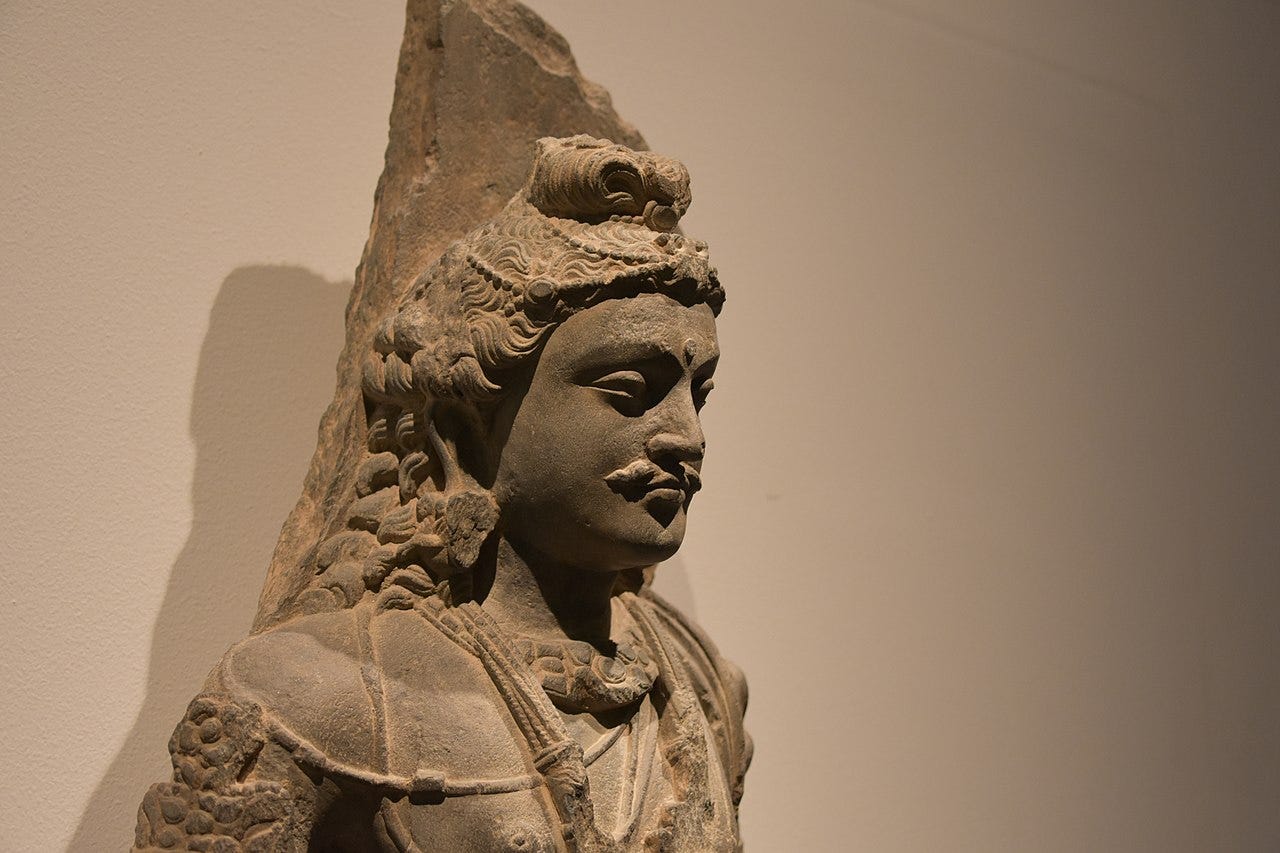
Not an unusual name in certainio parts of the world, not new to me. But I looked it up. The Future Buddha. The Coming One. The promised arrival in Buddhist eschatology who will restore the dharma when it has been forgotten. Version 2.0 of enlightenment. A reboot.
And there it was: the pattern.
I. The Discovery
Every major tradition has one. Judaism has its Mashiach, who will gather the exiles and rebuild the Temple and usher in an age of peace. Christianity pivoted its entire existence around claiming he already showed up, then had to invent a Second Coming when things didn’t immediately improve. Islam has the Mahdi, who will appear alongside Jesus — yes, Jesus — to defeat the Dajjal and establish justice. Zoroastrianism has Saoshyant, who will resurrect the dead and purge the world with molten metal.
Even Hinduism, which tends to view time as cyclical rather than linear and usually avoids the whole final-resolution thing, couldn’t resist. Kalki, the final avatar of Vishnu, will arrive at the end of the Kali Yuga riding a white horse, sword drawn, ready to reset the cosmic odometer.
The structure is always the same: things are broken, someone is coming to fix them, until then maintain your subscription.
It’s a brilliant system. The promised savior functions as a release valve for existential pressure. You can acknowledge that yes, things are comprehensively wrong, injustice everywhere, suffering built into the operating system, death waiting for everyone, while simultaneously insisting that the fix is already scheduled. It’s in the pipeline. Just wait.
The genius is in the timing. The messiah is always coming, never here. Not yet, but soon. Maybe in your lifetime. Probably not, but maybe. This is the Version 2.0 Problem: the current version is acknowledged as insufficient, buggy, corrupted, fundamentally flawed. But the next version, the one that will finally work, remains perpetually forthcoming.
We live our entire lives in beta.
And before you dismiss this as ancient superstition that modern people have outgrown, consider how many of your neighbors believe that downloading consciousness into computers will solve mortality. Or that fusion power will solve energy. Or that artificial intelligence will solve work. Or that Mars colonization will solve Earth.
Same pattern. New costume.
II. The Costume Change
The Enlightenment tried to kill God but kept the narrative structure. Instead of a messiah, we got Progress — history as a linear march toward some eventually-achieved state of rationality, prosperity, and universal human rights. Never mind that this “universal” vision looked suspiciously European. Never mind that Progress required colonies, slavery, and ecological devastation to function. The story was too good to give up.
Marxism promised that history itself was the messiah. The dialectic would work itself out. The proletariat would overthrow the bourgeoisie. True communism would arrive, and with it, the end of alienation and class struggle. Never mind that the dictatorship of the proletariat somehow never got around to withering. Never mind the gulags. The math was solid. The future was inevitable. Just wait.
Capitalism promised the invisible hand would eventually optimize everything into prosperity. Innovation will solve scarcity. The cream will rise. Wealth will trickle down. Just wait for the next boom cycle. Just wait for the next technological revolution.
The tech industry is especially shameless. Every product launch is framed as a step toward utopia. Social media will connect humanity. AI will free us from drudgery. Cryptocurrency will democratize finance. Each innovation creates new problems that require new innovations that create new problems. It’s messiahs all the way down, each one promising to fix what the last one broke.
The messiah doesn’t have to be a person. It can be a moment, a movement, a technological breakthrough, a singularity. What matters is the function: something is coming that will resolve the fundamental tension of existence. Until then, endure. Subscribe. Wait.
The believer says: things are broken, a savior is coming, endure until then. The consolation is external: someone outside the system will intervene.
The modernist says: things are broken, a discovery is in the pipeline, endure until then. The consolation is systemic, the system will self-correct through progress, reason, or market forces.
The difference is zero. Both are deferral. Both say, “not yet, but soon.” Both let you off the hook for the present.
But there is one distinction worth noting: the believer admits to operating on faith. The modernist insists they have transcended faith entirely while constructing elaborate belief systems about the inevitability of progress and the superiority of reason. Which makes the modernist version arguably worse. It’s bad faith about bad faith.
III. The Fork
flourishing with science
a Sapiens’ notion, when on
quest, they encountered
eternal entropy— “Oh!
God is dead!” Nietzsche whispered.
That whisper is everything.
The Enlightenment promise was simple: science would reveal truth, truth would liberate humanity, liberation would lead to progress. Flourishing with science. Reason would triumph. The universe would become legible, manageable, optimizable.
Then they encountered entropy. Not as metaphor — as physics. The second law of thermodynamics. The universe has a direction, and it’s not toward order, optimization, or progress. It’s toward disorder. Heat death. Dissipation. Everything: stars, civilizations, consciousness itself is temporary pattern formation in a system destined to run down.
“Oh! God is dead!” isn’t triumphant. It’s horrified recognition. You killed the guarantor of meaning and found this underneath: a cosmos that doesn’t care about your stories. A universe grinding toward entropy while you pretend your theories matter.
Believing one could write a tanka by understanding the form and syllable count is high modernism — metis says it is a distillation of a moment.
This is the fork. Nietzsche goes one way. Institutional atheism goes another.
Nietzsche refused consolations. He didn’t replace God with Progress. He didn’t swap a religious messiah for a secular one. He stood in the wreckage saying “now what?” without reaching for a replacement structure. No certainty performed. No pedestal claimed. The horror is authentic because the uncertainty is authentic.
Geoffrey Hinton has the same voice. He helped build the systems everyone else is calling the next messiah, then stepped back and said he wasn’t sure they could be controlled. No triumphalism. No deferral. Just: I made this, I don’t know what it does, and neither do you. It’s more terrifying than any sci-fi movie because he delivers it in a flat voice with no horror score in the background.
Institutional atheism went the other way. It became high modernism dressed as rationality — the belief that scientific tools designed to measure mass and velocity can also adjudicate meaning, consciousness, and metaphysical truth. That mystery is just ignorance waiting to be resolved. That the universe, given enough time and research funding, will become fully legible.
This is indeed faith in a particular framework.
Watch Hawking discuss God’s existence with the same tone he uses to discuss cosmology. Same confidence. Same dismissiveness toward dissent. Same assumption that the tools designed for one domain; empirical observation, falsifiability, material causation, automatically work for another: meaning, consciousness, metaphysical claims. He seemed to think scientific understanding would make cosmic existence legible, the mystery would dissolve.
That’s not science. That’s a pulpit. It’s theology dressed as empiricism. Evangelizing for a worldview while claiming worldviews are primitive. Demanding faith in Reason while mocking faith itself.
Compare this to a scientist who understands limits: “Here’s what physics can tell us about matter and energy. Questions about why anything exists at all? Outside my jurisdiction.” That’s honest — as science and as epistemology. Knowing what your tools can’t reach is the crux of scientific knowledge.
The irony: Hawking’s priesthood doesn’t make him a lesser scientist. It can’t. Because the priesthood has nothing to do with science. When he pronounces on God’s existence, he has no scientific stakes involved. He’s not doing physics badly. He’s not doing physics at all. He’s doing epistemological fundamentalism. Refusing to acknowledge the limits of his own method, while wearing the authority of a discipline that depends on exactly those limits to function.
High modernism can’t admit limits because it doesn’t recognize them. If scientific rationality can’t address something, the problem must be with the question, not the method. Its sacred texts — and it has them — function not as philosophical inquiry but as propaganda. They promise the same thing every messiah promises: clarity is coming, the irrational will be defeated. Just wait for enough people to wake up.
Same structure. Different vocabulary. Same Version 2.0.
IV. What Gets Destroyed
High modernism doesn’t just defer; it destroys a particular kind of knowledge in the process.
James C. Scott calls it metis: practical, local, embodied knowledge that can’t be standardized or scaled. How to read soil for rammed earth construction. How to navigate complex social situations. How to make something beautiful through practice rather than theory. How a farmer knows when to seed based on signs that can’t be reduced to data. How a craftsman knows when the joint is right.
Metis exists outside the frameworks high modernism uses to recognize knowledge. It can’t be abstracted. Can’t be measured in controlled studies. Can’t be replicated in labs. Can’t be taught through manuals.
So high modernism doesn’t see it as knowledge at all. It sees primitive practice waiting to be replaced by proper science. This is how traditional building gets dismissed as backward. Vernacular agriculture replaced with monoculture and industrial inputs. Craft knowledge lost to standardization. Local ecological wisdom ignored in favor of universal models that fail when applied to specific places.
The destruction is systematic because acknowledging metis would crack the foundation. It would mean admitting that legitimate knowledge exists outside the framework. That some things can only be known through practice, in the body, in the specific.
I practice— Rammed earth construction: mixing soil by hand, sense of touch is more meaningful than the numbers from the Casagrande apparatus. Musical composition: learning harmonic motion through thousands of hours of practice, not through algorithms. Writing about copyright history in Tamil, knowing it won’t scale to global audiences but doing it anyway because the knowledge matters locally.
High modernism considers all of this obsolete. Concrete is more efficient. AI can generate music. English reaches more people. The metrics say so. But the metrics only measure what high modernism recognizes as valuable. They can't measure whether the thing you've made is meaningful. Whether it belongs to the place it was built. Whether it carries knowledge worth preserving.
Here’s where it matters for the argument: metis is the refusal to defer. It says the work happens here, in this soil, with these hands, today. Not when the system improves. Not when the theory is complete. Not when Version 2.0 arrives.
Which is precisely why high modernism can’t tolerate it.
V. The Alibi
But high modernism offers something metis doesn’t: comfort.
You can live the same mediocre life: concrete house, fossil fuel dependency, industrial food system, iPhone in your pocket and still signal progressive values. Tweet about exploitation. Perform activism. Demonstrate your alignment with the correct side of history.
The institution gives you cover. You’re part of the collective. You’re raising consciousness. You’re waiting for others to awaken so the real work can begin.
It’s the Version 2.0 Problem in miniature: you don’t have to change how you live because the system will change eventually. History is moving in the right direction and the progress is inevitable. Just maintain your subscription to the right ideology. Just keep signaling. Just wait. It’s a comfort you can’t afford to lose.
Even Sartre couldn’t resist. He staked everything on radical freedom, no essence preceding existence, no determinism, no external salvation. Just you and your choices and the terrifying responsibility of knowing there’s no script. He called it “condemned to be free.” Ideology, for Sartre, was bad faith: hiding behind systems that claim to know what you should do.
Then he became a Marxist. Suddenly history had a direction. The dialectic would resolve. Communism was inevitable. He spent Critique of Dialectical Reason trying to reconcile “you are radically free” with “history is moving toward communism whether you like it or not.”
I can’t tell if this was intellectual dishonesty, genuine evolution, or existential exhaustion — the need to believe that history would do the work consciousness couldn’t bear alone. Maybe Marxism was the boulder Sartre chose to push up the mountain, his way of committing to an impossible project because the alternative was unbearable.
The ambiguity is the point. Even the philosopher who established that ideology is bad faith retreated into one. The Version 2.0 Problem is that seductive.
Nietzsche didn’t have this problem. He didn’t believe in Progress. He didn’t dress his philosophy in historical inevitability. He stood in the ruins without reaching for a replacement.
That’s the difference between a philosopher and a believer.
VI. The Work
I'm sketching a piece of music. I might call it Maitreya.
Not because I believe in the Future Buddha or I think consciousness will evolve and that humanity is headed toward resolution. If anything, I’m deeply suspicious of all of that. I’m using the name because it marks the thing I’m wrestling with. The gap between what we promise ourselves and what actually arrives.
The music doesn’t resolve. It doesn’t offer catharsis. It doesn’t build to some triumphant conclusion where the tension releases and everyone goes home satisfied.
You might think that wouldn’t be music at all. You’d be wrong. Musicians know the trick. Bach wrote The Art of Fugue. Technically circular. You can keep playing it until you die. It’s cyclic. “Let us play this over and over again for it is beautiful.”
The Art of Fugue doesn’t resolve because resolution isn’t the goal. The beauty is in the recursive structure, the cyclic return, the pleasure of the pattern itself. You play it, it ends, you start again. Not because you’re waiting for something better. Because the thing itself is enough. Bach knew something about making beauty that exists outside high modernism’s demand for progress and resolution. You can’t standardize it. You practice it until you understand it by feel.
High modernism needs teleology. Music as narrative arc: tension, development, climax, resolution. Beginning, middle, end. But that’s not how existence works. There’s no resolution coming. The tension doesn’t resolve; it just continues until you stop hearing it. The journey doesn’t complete; you just run out of road.
I spent fifty days trying to get a single classical piece properly categorized across twelve music distribution platforms. The platforms were built by people who believe high modernism has solved music distribution. Everything can be algorithmically sorted. Everything fits the same template.
Except it doesn’t. Metis doesn’t scale. The things that matter to people who actually practice a craft are proper categorization, accurate metadata, respect for form. These don't register in systems designed for mass consumption.
When the practice doesn’t fit the theory, the problem is always with the practice.
VII. What Remains
Here’s the contradiction this essay can’t escape. I’m writing about ideology while standing inside one. I’m pointing at the Version 2.0 Problem while implicitly suggesting that recognizing it is somehow better, which is itself a version of the same problem. There’s no outside position. You can’t step out of ideology to critique ideology because the critique is already ideological.
Existentialism offers a way to live with this. Not a solution — a posture. You build meaning knowing the foundation is quicksand. You make choices knowing there’s no external validation. You take the broken system seriously because it’s the only system you have.
The comfort of the messiah myth, religious or secular, is that it lets you defer. Someone else will fix it. Progress will happen. Technology will solve. History will absolve. Maitreya will arrive.
No. There’s no fix coming. This is it. What are you going to do?
I’m still working on the piece. Still trying to figure out what it means to make something when you don’t believe in arrival. Maybe the point is that you make it anyway. Because the act of making is the only honest response to being stuck in a system that won’t resolve.
You can’t fix consciousness. You can’t opt out of mortality. You can’t wait for Version 2.0 because there is no Version 2.0.
So, you build things inside the broken version. Knowing they’re broken too. Knowing that whatever you make will be insufficient, temporary, and meaningless in a universe that doesn’t form grand schemes.
You build anyway. Just because you’re here and you have to do something with the time between birth and death, and making things feels slightly less absurd than not making things.
The music continues. Maitreya doesn’t arrive. The waiting is like waiting for Godot. Nothing resolves. The tension doesn’t release; it becomes the texture you live inside.
This isn’t despair. It isn’t hope. It’s the work of living without a messiah in a world that keeps promising one. The work of making things that don’t promise salvation. The work of building on foundations you know are provisional.
The work continues. That’s all there is.
It is what God did too.
What is your metis? What is the thing you do that doesn't scale, won't be optimized, and exists only for the meaning of the work itself?