

General Ludd’s Real Complaint
The machine didn’t steal the weaver’s job. It stole the thing the weaver knew.

A boy named Ned Ludd, an apprentice weaver in England, smashes two stocking frames in 1779. Maybe out of rage, maybe after being punished by his master. Nobody knows if he was real. But thirty years later, his name is signed on threatening letters across three counties. He's been promoted to General. He lives in Robin Hood's cave. He commands an army that doesn't exist, led by a man who may never have existed, and the British government send more soldiers to fight him than it has fighting Napoleon.
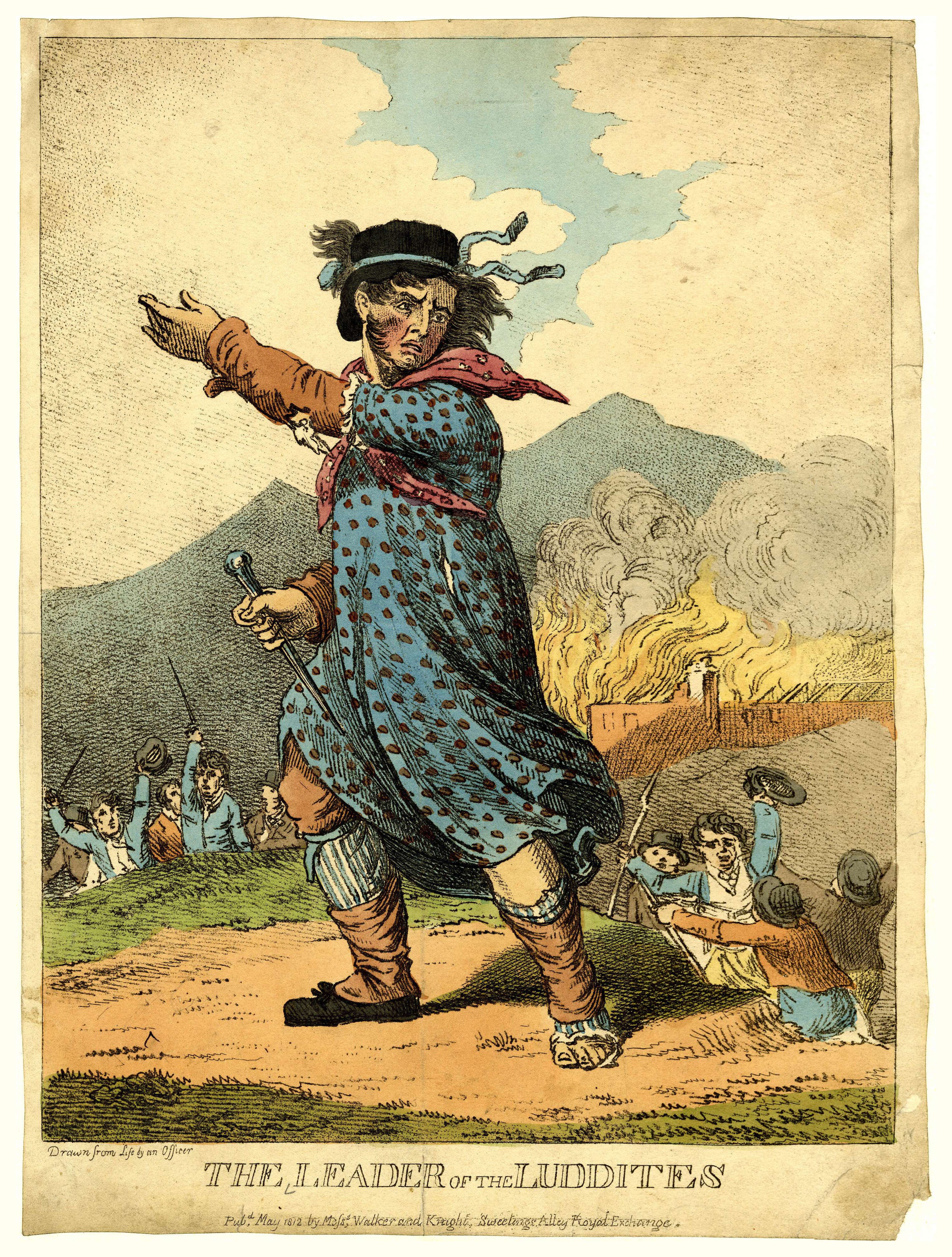
Before the industrial revolution, a crafts man called cropper knew the cloth.
He stood over yards of woolen fabric with hand shears that weighed forty pounds, and he cut the nap, the raised surface of the wool with a precision that took years to learn. The angle of the blade, the pressure of the stroke, the reading of the fabric’s grain under his fingers, everything was crucial. He could feel when the cloth was right. He did not measure but feel the cloth.
This knowledge lived in his hands. It could not be written in a text. It could not be explained to someone who had not stood at the shearing frame for years, learning through error, through fatigue, through the slow accumulation of a body’s education. The cropper’s skill was illegible to anyone who did not share it. It could only be transmitted hand to hand, master to apprentice, the same way Vedic chanters transmitted pronunciation, correction in real time.
Then someone built a shearing frame that did it mechanically. One unskilled worker could now match the output of several trained croppers. The cloth still got finished. The nap still got cut. The product looked the same.
The knowledge stayed in the hand of the cropper — gone.
The Luddites — the army of Ned Ludd who was a legend. These people are remembered as people who smashed machines because they feared progress. This assumption is convenient and wrong.
The men who gathered on the moors above Huddersfield, England in 1811 and 1812 were not frightened peasants. They were highly skilled artisans. Croppers, framework knitters, handloom weavers, who understood the machines better than the factory owners who bought them. They were technologists themselves. They had spent years mastering complex equipment. But they hated what machines were being used to do.
In Nottinghamshire, the framework knitters’ grievance was specific. The traditional narrow frame produced “fully fashioned” stockings. Knitted to the shape of the leg, a process that required real skill. The new wide frames produced flat sheets of fabric that were cut into stocking shapes and sewn together. The knitters called these “cut-ups.” They were knitted at the seams. They came apart at the seams, and everyone knew it. The knitters were not opposed to the frame but to using it to produce inferior work and calling it the same thing.
In Yorkshire, the croppers faced extinction. The mill automated the finishing of woolen cloth. In Lancashire, the power loom moved weaving from the cottage to the factory. They did not need skilled craftsmen; an unskilled child was enough. In each case, the specific complaint was that the machine was being used to replace the craftsman, with someone who knew nothing about the craft.
Ned Ludd who smashed two stocking frames probably was a fiction. But by 1811, the name had been elevated to “General Ludd,” a mythical commander who supposedly lived in Sherwood Forest. But he didn’t exist; the authorities couldn’t arrest him. The fiction gave a decentralized movement the shape of an army.
And the army was disciplined. The raids were conducted at night by masked men who marched to specific workshops and smashed specific machines belonging to masters who paid below the standard rate or used unapprenticed labour. They spared the machines of “fair” masters. This was not blind rage. It was selective and strategic. A form of regulation by sledgehammer, in a country whose government had stopped regulating on behalf of workers.
The sledgehammer had a name. They called it “the Great Enoch.”
The name was a reference to the blacksmith firm of Enoch Taylor & Sons, which manufactured both the shearing frames the factory owners used and the sledgehammers the workers swung. The same forge made the machine and the weapon. The Luddite slogan: “Enoch made them, and Enoch shall break them.”
There is something in that sentence that belongs in every essay in this series. The tool that displaces you and the tool you use to resist — they come from the same place. Writing displaced the dialogue and preserved the argument against writing. The clock displaced felt time, and the clock towers became the landmarks around which community life reorganised. The press displaced the scribe and made possible the pamphlets that mourned what was lost with the scribe. The machine displaced the hand, and the hand picked up a hammer made by the same forge.
The displacement and the resistance share a source.
The government responded the way governments do. They sent soldiers. Between twelve and fourteen thousand troops to the industrial districts by 1812. More than what they had in the war against Napoleon. The industrial north was placed under military occupation.
Parliament passed the Frame-Breaking Act, making machine-breaking a capital crime. Lord Byron the poet, in his maiden speech to the House of Lords, opposed the bill. He asked whether the price of a stocking frame was really worth more than a human life. He called the workers “misguided but most unfortunate fellow-countrymen” driven to desperation by poverty and neglect. He was one of the few who understood what the Luddites were actually saying.
At the trials in January 1813, seventeen men were hanged. George Mellor, the leader of the Yorkshire croppers, was among them. Dozens more were transported to Australia. The Luddite movement was smashed —no sledgehammer.
But here is what General Ludd was really saying, underneath the letters and the sledgehammers and the raids.
He was saying: the knowledge is in the hand.
The cropper’s skill was not information. Not a procedure that could be transferred to a machine and executed identically. It was embodied knowledge, the kind that only exists inside a human body that has spent years learning through doing. The tension in the wrist. The reading of the grain. The feel of the blade meeting the fabric at the right angle on a cold morning when the wool behaves differently than it does in summer.
This kind of knowing cannot be separated from the knower. You cannot extract it and put it in a machine. You can only replace it with a mechanism that produces a similar output through an entirely different process. The cloth gets finished either way. But in one case, a human being knew something. In the other, a machine performed something. The product looks the same. The knowledge inside it is gone.
And no one can tell the difference by looking at the cloth. That is what made the displacement so easy and acceptable. The loss was invisible.
This is the deepest displacement so far in this series.
Writing killed the living voice. But writing was still made by a human hand. The clock killed felt time, but the monk still rang a bell. The press killed the intimate book, but the printer still set each letter of type. In every previous displacement, the human hand was still somewhere in the process. Diminished, perhaps. Less central. But present.
The factory removed the hand entirely. For the first time, the product could be made without any human being knowing what they were making. The child tending the power loom did not know cloth. The machine did not know cloth. Nobody in the factory knew cloth the way the handloom weaver had known it. The knowledge didn’t transfer from person to machine. It simply ceased to exist.
The majority welcomed the factory. Of course they did.
Cloth became cheaper. Clothing became affordable. The mill towns grew, and wages attracted people from the countryside where the alternative was starvation. The Industrial Revolution made the modern world. Medicine, infrastructure, education, democracy as we know it. None of it possible without the surplus that mechanised production generated.
The croppers were right about what would be lost. The factory owners were right about what would be gained.
Both sides are right. Every single time.
George Mellor was a young man when hanged. He was a skilled cropper, and by all accounts a leader others would follow into the dark. The knowledge in his hands died with him. His hands were already obsolete before he was executed. The shearing frame was already faster, already cheaper, already spreading to every mill in Yorkshire. The hanging just made it official.
The Great Enoch could break the frames. It could not save what the frames had already made unnecessary.
General Ludd’s real complaint was never about the machine. It was about what happens when a society decides that the product matters more than the process, that the output matters more than the knowing, that the cloth matters more than the hand that understood it.
We made that decision. We are still living inside it.
Next in the series: Canned Music: recorded music and the death of presence.